Showing posts with label family memories. Show all posts

Wednesday, June 28, 2017

The meeting (redux)

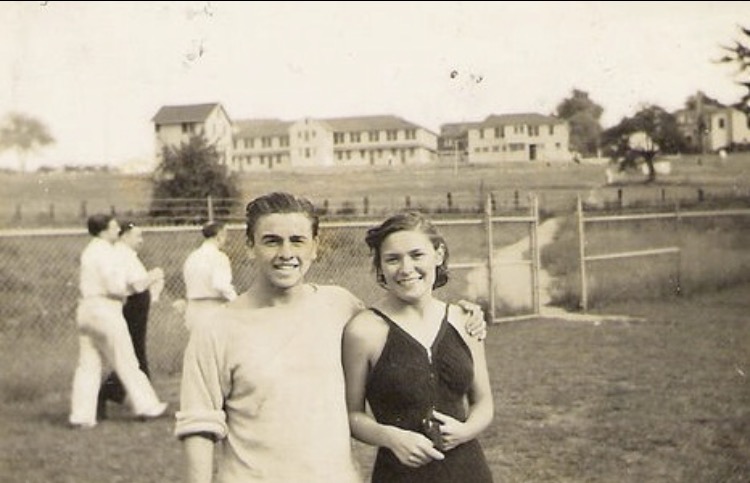
I posted a picture of my mom and dad, the weekend they met 80 years ago next week, on this, the 8th remembrance of her passing. The picture seemed to have struck a cord with a lot of folks, so I am reposting (from my old blog) this account (approved by my mom when she read it) which was originally posted July 6 2005.

It was 1937.  July 4th weekend, Mount Freedom (New Jersey, I think). A resort of sorts. She was 16.  He was 18.

She was there with her brother and his friends as a thank-you for helping out in his office while his assistant was on vacation.

He was there with his buddies, Harold and Phil, part of an irrepressible boyhood trio that stayed friends to the end of their days.

She was watching some boys play ping-pong.  Her brother asked if she wanted to go along to watch some tennis.  "No", she said.  "I'm going to stay here and beat this boy at ping pong."

They played.  The ball bounced from side to side.  Quips and laughter also bounced between them.  The game ended.  I never learned who won.

She joined her brother for lunch.

He found his buddies.  Years later Harold told her that he pointed her out to his friends at lunch.  "Which one?", asked Harold.

"That one", he replied and pointed to her as she walked away with her brother.

"Ah," said Harold.  "The girl with the resonant buttocks."

It must have been quite a walk she had when she was young.

Later that day, she went swimming.  Suddenly, he popped up in front of her in the pool.  He'd done a stealth approach, swimming up underwater, to surprise her.  They spent the afternoon together, but he didn't show up at the dance that was held that night.  There is a picture of him with another girl he knew from that weekend.  Nearly 70 years later, she recalls that he never told her where he was that night and why he didn't come to the dance, but she suspects it had to do with the other girl.

The next morning she packed up to go home to Brighton Beach.  While her brother was checking out, she stood alone.  He came and joined her and asked if he could call her.  She gave him her phone number.  She was 16.  He was 18.  When he died, 44 years later, that scrap of paper with her phone number was still in his wallet.  "I still have it somewhere", she muses.

He did call.  And took the train forever and  a day from The Bronx to Brighton Beach.  They walked with friends along the boardwalk.  As they strolled, they met her father and uncle, coming back from their morning walk.  It was the only time he met her father.

He wrote her letters.  Beautiful letters.  A love poem that was a parody of The Raven.  She saved it for years, but then got mad at him one time and threw all his letters out.

"Are you sure you want to do that?", her younger brother asked.

"Yes!", she replied vehemently.

"You may marry him some day." her brother said.

"Never!" was her response.

Her brother retrieved the love letters from the trash and copied them in his own hand.  Sent them to the girl he would marry--who once confided to her that Her younger brother was such a good writer and a poet.  Did She know that  Her brother written a love poem based on The Raven?

She was furious.  "It was good stuff." her brother told Her.  "And you didn't want it.  Why should it go to waste?"

Their second date, they met at Cousin Ethel's house rather than him having to make the long train trip out.  And their third date, too.  After that, she knew him well enough to meet him in the city.  They dated on and off.  She went to College--Brooklyn College.  He took time off between college and starting Medical school to go to Albany.  He asked her to meet him at the train to see him off.  His whole family was there.  It was the only time she met his father.  "If I'd have known his family was going to be there, I wouldn't have gone!", she now confesses.

She was 16, he was 18.  They dated on and off, and she would get mad at him and tell him to go away.  He was too fresh.  But he always came back.  One night her aunt complained to her mother that she was sitting out on the stoop too late in the night with that boy.

"Mama," she said.  "Do you know what we were talking about?  We were discussing the dorsal dissection of a cat."

She'd send him packing.  He'd come back.  Other boys wooed her.  They didn't win her.  For, suddenly, one day, she realized she loved him dearly.  And couldn't live her life without him.  When he'd hear her tell the story, he'd smile.  He knew, you see.  He knew from that first day.  When she was 16 and he was 18.

Pictures from the Mt Freedom Weekend. She made the sundress she was wearing. He probably threw the game to talk to her some more




Thursday, May 25, 2017

Daddy Sandwich

My father was many things: brilliant scientist, gifted actor, always ready with a quip or pun, loving father, trusted husband. He was not, however, much of a cook. I remember he barbecued for a bit, on a grill that he imbedded in a cement wall (to keep his young children from running into the hot grill)... until the wall fell down one day, because apparently my father was not that gifted with cement. However, he would, upon occasion, make for us something he called Daddy Sandwich. It was a treat at the time, mostly because it was prepared by him, but also because it was tasty. He toasted whatever bread we had in the house at the time (white, pumpernickel, or rye were the most likely candidates) and then added a layer of cream cheese. On top of this, went a layer of canned salmon, carefully mashed. (Fresh was not easily available. For the first 10 years of my life I thought salmon came from a can, or from the deli as lox.) He trimmed the crusts off the open faced sandwich, then cut it on the diagonals to yield 4 triangles of deliciousness.

This morning, I made a Daddy sandwich. No matter that the bread was gluten free, since I've developed a wheat allergy, or that, thanks to my Ashkenazi heritage, I prefer to use lactose free cream cheese, and that the salmon, was leftover wild CoHo salmon I broiled last night, or that I left the crusts on, because, why not? It was a Daddy Sandwich, and I was so happy to share my breakfast with his memory.

Saturday, January 14, 2017

Resting in the arms of Love

My father used to say he was a trendsetter. After all, he'd called people meatheads for years before Archie Bunker nicknamed his son-in-law that on  All in the Family. He also had a chair, a throne, that no one else was supposed to sit in besides him. One of the first purchases he and my mother made in 1968, when the family finally moved out of the little house that had been our home for 17 years, was a recliner just for him. I remember sitting on the arm of the chair, or on the floor near by, talking with Daddy about his life as a child actor, and growing up in the Bronx.  But to sit in it, myself? Never! (except if he wasn't home and I wouldn't get caught!)

An aside: My favorite story was when he was cast as "the pest" in a silent movie called Womanhandled, and the cast had to go on a road trip to Texas to film scenes where Richard Dix was pretending to be a cowboy. My father was a little kid, maybe 6 or 7 (though he was diminutive, as I am) and was playing the part of a 4 year old brat. Regardless, he couldn't travel alone, so my grandmother accompanied him. She, however, kept strict kosher, and refused to let him eat what the rest of the cast did. She bought food and prepared meals for the two of them. And when there was a barbecue in the cast's honor, she held fast and refused to let him eat all that wonderful food-- which was why my little Jewish grandmother and her son were the only two people in the entire production that did not come down with food poisoning afterwards. Sometimes religious dietary laws really come in handy.

By the time I'd gone off to college, the rules had relaxed. We all knew, though, that once my father got home from work, The Chair was his, and we had to park our bottoms elsewhere. He even co-opted  a hand signal that was actually a punchline to a joke -- a hand signal in the joke that meant "enough of that shit". 


(Left: that's me, in 1977, with our mutt Patonka and my flute, and some very stylish glasses, in The Chair. It's hard to describe the fabric. A modern weave that was kinda scratchy, enough so that you never wanted to sit in it in shorts. )

That chair traveled with the family from St Louis to Charleston, back to St Louis. After my dad died, the chair became my mother's throne. It travelled with her one more time, back to Charleston when we joined households. By this time, it was a bit tattered, so she had it reupholstered. Javaczuk marveled that she was able to find another fabric just as scratchy. 


At some point, my mother decided that though she loved The Chair, it was becoming hard for her to get in and out,  or to push it back to recline in, so she got another chair. The Other Chair wasn't allowed in the living room, because The Chair ruled there. But later, when we'd shifted to the house on the lake, the Other Chair, emerged and became part of the room we all spent the most time. I remember my nephew, who now is in high school, crawling all over it when he was under two, and delighting that he could make the seat of Other Chair shift into a reclining mode. After a bit, Other Chair, shifted again up to the cabin, so my mother could have a comfy spot there. Most of the pictures I have of her in it are really terrible, but I like this one,  because I love how she's bundled up inside the cabin, during winter (yes there was a fire going, maybe 5 feet away from her). As one who also is always cold, it makes me realize I come by my tendencies honestly.
The other picture, which I also love,  though it is not of my mother, was taken in 2006 or 2007. (The dating of it comes from the knowledge that we changed the curtains in 2007 and painted the door, but it was in the fall and this visit was spring.) Heatherico came up to the cabin with me for a visit. You can see who claimed the green chair in a characteristic arms over head pose.

We are now talking about selling the cabin, moving into yet another new phase of life. Some of the furniture will convey, some we'll sell, and some we'll keep. When the fires threatened the area, it was a lesson in "what would I miss the most? " There aren't that many things I really want to keep:  a painting or two, a gift from Heatherico I treasure, a picture, some things Javaczuk wants, and, the chair. But I was resigned that it might not be a possibility. Luckily, the forest fires, though they were close, didn't directly threaten our little haven. And when my sweetheart went up to winterize the place (there still was too much smoke in the area for me to safely go), he came back with what he could fit in the car from our list, including the chair.

We have it set up in our room, where Javaczuk has a reading nook in one corner and I now have one in the opposite corner. I started meditating in an effort to help improve my breathing and health, and the chair is my place of choice. I delight in curling up in it to read, or to have my tea. It's comfy, designed for diminuitve folks, and is stuffed full of memories. And every time I sink into it, I feel I am resting in the loving arms of dear ones now gone.
SaveSave

Thursday, January 12, 2017

From crockpot to cracked pot

Funny what strikes that sentimental spot in the heart. I've been thinking about my parents a lot lately, and mulling over the words for a post, but something else, equally sentimental, jumped queue.  Of all things, it is a crock pot that is pulling at my heartstrings.

When I moved out of the dorm, during my University years, my mother gifted me with a crock pot. (For the uninitiated, a slow cooker, that essentially let you heap lots of stuff into its maw, turn it on, and let it cook all day.) Yes, you can do the same thing with an oven, but this had the air of convenience about it. In essence, it was an electric bean cooker, that clever cogs over at Rival turned on to those of us who didn't have bean pots simmering on the back of our stoves. I used mine for stews, small roasts and fowl, and glorious soups. I still have that crockpot-- it's up at the cabin, with an ill-fitting lid from the days when I was at MUSC Children's and our division would do fundraisers which involved a lot of chili, hot dogs, and other sundry food items. (Somewhere out there, one of the other pediatric nurses has a crock pot with an ill fitting lid, because she got mine, instead.) I loved the meals that pot made, but honestly, it was a pain to clean. When my mother moved in with us, and brought her newer crock pot, with a removable crock lining, I switched loyalties and never looked back.

Mama's crock pot cooked up some great meals for us. I can't speak to what it did prior to 1988, when we all moved into a home together, but from that point on, that crockpot and I earned a heap of praise. (A token of how much I preferred it, is that it never had to make the trek to the MUSC Maternal-Child  Nursing lunches mentioned above. Little red was expendable once my mother's crock pot came into our lives.)

I used it weekly now, especially with just the two of us here at home. I can take a whole chicken from  the butcher, to roasted, to stew, and then use the bones for bone broth, all with the same kitchen helper. And the "set it and forget it" mode has always appealed to me, especially when I've had a day full of medical visits and appointments, and then walk into a home filled with the aroma of something roasting in the crock pot.

But a few days ago, as I cleaned the crock (as opposed to cleaning someone's clock) I noticed that after 35 years, there's a crack forming in the bottom of the crock. And, sadly, it goes clear through, though nothing has leaked yet. But, it's not long, I fear. Plus, I worry about the integrity of the crock and if whatever's under the glaze might not be safe if the glaze isn't intact.(There was a "Lead in slow cookers!" scare a few years back.)

Today, I retired my mother's crock pot. I did a lot of looking for a replacement, and while there are ones out there with bells, whistles, timers, and all sorts of extras. I'm not taking it tailgating, or serving dips or meatballs from it at parties. I didn't need handles, or vacuum sealed, or a carrying case. I didn't need a special slot to slip a meat thermometer.  No temperature control or timed settings.. I just wanted simple-- and a removable crock for cleaning.

Most places I checked locally (before resorting to Amazon or big box stores) only had the fancy ones. But I found my simple little crock pot, on/off with a few stops in between, and a removable liner. The woman who helped me at the store was delighted in my choice. She and I each showered praise on the simple crock pot, sharing recipes and memories (we'd each cared for our mother, each had one son, each worked full days which were often rescued by coming home and smelling the fragrance from the pot we'd set to cooking before we left for work.) Sure this one is a little 2017-- it's got a stainless exterior, but it's the innards that hold the real beauty. I'll put it through its paces this weekend. Prepare for some good smells and good eating... and a toast to my mother.

Sunday, January 8, 2017

Thanks from Harry, and the rest of us, too


A few weeks ago, a neighbor I was quite fond of died. He was born the same year as my mother, which put him at 95, three years younger than my father would have been. In the aftermath of my neighbor's passing, others have spent time sharing small stories of him. At one point, someone praised the fortitude and remarkable nature of so many of my parent's generation, remarking they weren't called "the Greatest Generation" for nothing. 

In going through some more memorabilia, I found this letter from Harry Truman. I like to think it shows a certain class and dignity I have long associated with the Office of the President. 


 I've now looked up the birth year range of The Greatest Generation (formerly the GI Generation) and see that it spans from 1910 to 1924.  And though the youngest would be 93 and the oldest 107, I, for one, am still grateful for their service and sacrifice.


Friday, September 11, 2015

Roofus Rastus Johnson Brown

Once upon a time there was a girl from Brooklyn. Her parents, Ada and Avram,  had come to America from the old country, found each other, and settled into a life together on New York's East Side, selling eggs from a wooden cart. Shortly after she was born, Ada and Avram  moved their young family from the city to the fresh air of Brooklyn, settling in a brownstone near the  Brighton Beach boardwalk. Though Ada and Avram had travelled many miles from the countryside near Lviv, the girl from Brooklyn didn't travel much. Her entire family, for the most part, lived within blocks of the her home. She travelled through the books she read, and dreamed someday of a great adventure.

The family grew, adding a couple of brothers (one having been her father's oldest son, whose mother had died in the old country during the Spanish Influenza epidemic, and was finally able to immigrate to live with his father and new mother), and a sister. The girl from Brooklyn blossomed. She had a joyful nature, an inquisitive quick mind, and the ability to give wholehearted attention in a conversation. She also was extremely teasable, and even in adulthood would sputter in protest when her younger brother sang "Rufus Rastas Johnson Brown, whatcha gonna do when the rent comes round" and called her Rufus, instead of her given name of Ruthe.

The girl from Brooklyn loved and was loved. In her twenty-first year, she wed. She still dreamed of travel, but she and her Eli were young, limited in funds, and it was wartime. Eventually, though, they were able to begin to take road trips to explore this beautiful country, as well as travel to move their own clan to new locations as Eli's studies and work required.

Looking back now, her journeys can be traced through the souvenirs she collected. Her charm bracelet gathered tokens from New York, Massachusetts, and other eastern seaboard states. Eventually, she added Wyoming to the chain. The bracelet also documents the three children Ruthe and Eli brought into this world, two boys and a girl (I am that girl, now grown, myself.)

At some point, the charm bracelet got full, but our Ruthe still wanted to get a token to commemorate  her travels. As a young girl, she'd been given a spoon from Rockaway Beach, which she treasured. She began to add small spoons as souvenirs for each state she visited. Soon she had spoons from coast to coast.


When the girl from Brooklyn, who had gone on to live in Washington DC, Pennsylvania, Maryland, Missouri, and South Carolina, left this life in 2009, she left behind many who loved her. She also left behind her spoon collection. Occasionally, I'd take the spoons from the box where they rested and remember our times and travels together. The collection was one of the things I kept when we downsized from the family home to our current abode. But what do you do with a collection of state spoons besides dust them?

It's no secret that I have a love of art, particularly the vibrant artists that we have come to know here in Charleston. Last year, we first saw the wonderful works of an incredibly talented and imaginative metal artist here in Charleston. Since then, we've had the good fortune to become friends with him, and marvel at the works, large and small that he creates. But when I saw Matt Wilson's (aka Airtight Artwork) silverware metal sculptures, I knew what had to happen with my mother's spoon collection.

So far, only one little guy has been created -- the smallest bird Matt has yet done. Its tail feathers are the spoons of South Carolina and Colorado, which makes me smile for many reasons. And even more thrilling for me was that I had the opportunity to add my own touch into this little bird, and will be collaborating with Matt on some future projects. This one, however, stays here with me. I've named him Rufus, in honor of that old song that my uncle used to sing to torment his big sister.


Saturday, June 13, 2015

Rutheli Redux

For those who read my earlier post, Rutheli, about the wartime wedding of my parents, I found this picture from a scrap book of the second wedding, June 13, 1943. The reception took place at The Commodore, "New York's Best Located Hotel" on 42nd St.
You two created a family filled with love. You're gone, but your memory still brings joy. L'chiam!

Wednesday, June 3, 2015

RuthEli

Ah those crazy, impetuous kids, and entirely sensible kids. The wedding invitations said June 13. The dress was finished, tuxedo fitted, seating charts finalized, chuppa at the ready. A crystal glass waited to be broken. The marriage license obtained in advance, to make the religious ceremony legal, was tucked away with the groom's gear. The Rabbi had the date in his book. Even Zaydeh was remembering his youth, dreaming of dancing with a beautiful bride.

But it was June 3, 1943, and here they stood, in giddy anticipation. He'd gone to enlist in the army, and when the sergeant heard that a wedding in 10 days would change the check in that little box from single to married, he shook his head and said (paraphrased here, of course), "Look kid. Take my advice and go take your girl to city hall and get married now. Trust me. It's easier to do that than to get your marriage status changed in the army. Then come back and join up."

So, he called his girl, and explained the situation. She took an early lunch break from her job in a lab at Brooklyn College, and grabbed her younger sister Shayndyl. He grabbed the rings and his best buddy Harold. Off to City Hall they went, license in hand, rings in pocket, witnesses at their side. 

Before a New York City administrator, they promised to love and cherish each other. He pronounced them husband and wife. They kissed to seal the deal, hugged their witnesses, and thanked the official. Then he went back to join the army. She went back to work. I imagine each had a secret smile on their face.

Ten days later, they wed. I don't know if her grandfather or brother walked her down the aisle, as her papa had passed 6 years before. (She was always happy that Papa had met her Eli one day, as they walked the boardwalk at Brighton Beach, where she grew up.) But I've seen the film of the wedding reception, and know that that Zaydeh (my great grandfather) danced with his granddaughter, the first of his grandchildren to wed. It brings tears to my eyes every time.

Not so long ago, the shade of my heart (Wheel of Time reference there, for those who didn't get it) gave me a ring to replace my engagement ring, which has become perilously frail, having been worn first by my mother who gifted it to my beloved to give to me when we pledged our troth and became engaged. The new ring, a blue topaz, is slightly too big, and I've not yet resized it. I pulled two plain bands from my jewelry box to use as ring guards for my lovely ring, and alternate which I wear. The rings have been mine for only 6 years, but in my life always. They are my parent's wedding bands, which I visualize as holding the joy of their long marriage, releasing the rest.

Today, I smiled, and slipped both rings on my finger, with my own wedding band and the topaz. Reunited. Happy anniversary Mama and Daddy. Ikh hob ir lib. 


Sunday, August 25, 2013

50 years from King's Dream

50 years ago, I wasn't there. But I was close. At age 6, my options were limited. It was really only one thing that stopped me from being on the Mall in Washington DC. One thing. One formidable thing: my father.

I grew up in the suburbs of DC. Our neighborhood was squarely in what then was middle class. Moms for the most part were stay-at-home. Dads went off to the office every morning with a kiss; kids went off to school with a packed lunch (and also a kiss), plus, in my case, the admonishment to be a good girl. Most of the neighborhood voted for Kennedy, and were staunch Democrats. Divorce was basically a nonentity; the only single household in the neighborhood was headed by a widow. Most families were of Jewish heritage. All were Caucasian.

My parents were a little different from their neighbors. They'd been born to Jewish families, but each, for reasons of their own, had renounced their faith. When they married, they searched, together, for some place to hang their beliefs. They settled on The Ethical Society. When kids came along, we were raised in Ethical Humanism. There was acknowledgement of our Jewish heritage, in that we lit a menorah, and ate latkes and rugalach, but we never attended synagog unless we went with friends. Instead, we went to Sunday school at the Washington DC Ethical Society. We learned that all people were created equal, and had only some minor confusion when one of us smuggled a bible to our Sunday School class, and created a dilemma for the Ethical parents parents, who had been busy teaching us about anything but our Judeo-Christian heritage, which they had rejected. (But that's another story.)

When the Civil Rights movement began, the adults at the Ethical Society were right on board. While we kids were learning about Buddhism and Taoism, our parents were following the speeches of Dr Martin Luther King. Some from the Society went to join the movement deep in the south -- the equivalent of of Ethical Mission service. We followed. We believed. We sang "We Shall Overcome" and meant it.

But that sultry August before I entered second grade, we knew something special was happening close to us. We knew Dr Martin Luther King, the man with the amazing voice of the cause of equality, would be in our town.

I don't remember all that much of the build-up to the actual March for Civil Rights. I was not yet seven, and my parents had guarded me from some of the horrors that had occurred in our country. But I do remember hunkering down  on the steps, eavesdropping on my parents as they discussed the upcoming event. My mother desperately wanted to go down to the Mall, along with several other adults from Ethical (as my parents referred to their Sunday gathering spot.) But such was life at the time, that she wouldn't go against her husband's wishes. My father, while he believed in the cause, was a realist. He was convinced that there was a real possibility of violence at the March, from the "meat-heads". He refused to let his wife go, and was adamant that his children not attend.

I remember my mother weeping quietly. Happily, my father's worries proved unfounded. The march remained peaceful. But I still remember how my mother's eyes shone as we all sat around our RCA radio, and shared moment when Dr Martin Luther King spoke of his dream.