
Sunday, February 2, 2014
A Tale Dark and Grimm by Adam Gidwitz

Saturday, February 1, 2014
Wesley the Owl by Stacey O'Brien

Wesley was a 4 day old injured fledgling barn owl when Stacey O'Brien, a biologist working with owls at CalTech met him. His injury was such that he could not be habilitated to survive in the wild successfully, and he was placed in Stacey's care. This book is the story of the remarkable relationship that followed over the next 19 years. It's a wonderful story, full of juicy facts for bird lovers, and wonderful stories for animal lovers in general, both heartwarming and heart-breaking. And yes, Wesley dies in the end, but not before surpassing the life expectancy of a barn owl in the wild, which is roughly 15 years. His distinct personality will remain with me as well as much that he and Stacey taught me. I also applaud the author, for she truly reshaped her life around her charge, even though she kept his presence in her life relatively quiet, for fear of activists who were bent on freeing "captured" wild animals setting Wesley loose into a habitat he would have been unable to survive.
The tag line for this book is "the remarkable love story of an owl and his girl." I couldn't agree more.
Sunday, January 19, 2014
Hyperbole and a Half: Unfortunate Situations, Flawed Coping Mechanisms, Mayhem, and Other Things That Happened by Allie Brosh

Brosh's honesty is charming, eye-opening, heart-rending, and sometimes painful to read. She approaches mental health issues that most people skirt away from, or sweep into a closed. Her courage is what makes it easier to read (if she can write it, I owe it to her to read it) -- well, her courage, and her wonderful drawings that can capture so much with such sparse detail.
But the book is not all emotion -- there are some wonderful stories of life, dogs, a goose in the kitchen, and young post-op, still- anesthetized Allie wanting to go to a party. Love.
(One additional mention: Allie lived in Sandpoint Idaho for a bit and was friends with a friend of mine who lives there. One degree of separation!)
Sunday, January 12, 2014
The Case of the Love Commandos (Vish Puri #4) by Tarquin Hall
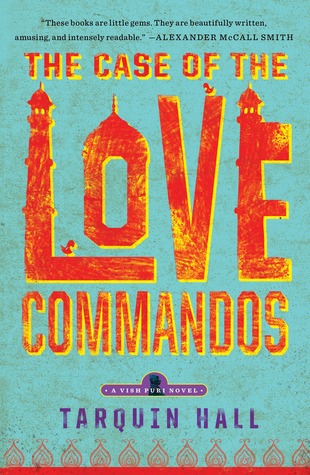
This time, Vish Puri is feeling a little blue after a string of bad luck (for instance, he solved a case of a heist, but couldn't find the goods.) He's off with his wife and mother for a trip, when he gets called away by one of his agents to help find a missing groom. No, the guy hasn't gotten cold feet -- he's been kidnapped. He is of a different class than his beloved, and at the same time she's run away to run away with him, he vanishes. His mother, back in his village, turns up murdered, and the father of the bride to be is accused of the crime.
The twists and turns normally would be great fun for me, as well as watching Vish's ego and brains at work, but it just didn't fully cut it for me right now. Even the recipes at the end of the book didn't grab my interest, so I really must be preoccupied, because after reading, one of my favorite things to do is cook.
Forgive me Vish?
Wednesday, January 8, 2014
Death of a Nightingale (Nina Borg #3) by Lene Kaaberbol, Agnete Friis

This is apparently the third in a series featuring Nina Borg, but the story didn't suffer in not having read the first books. Nina is definitely a flawed character, but also definitely one with a good heart. She has worked with immigrants, both legal and illegal, in Denmark. Through this work, she has befriended Natasha, a woman currently in jail for the attempted murder of her fiance, and Natasha's daughter, a child with severe asthma, who bears the emotional scars of her young life. When Natasha escapes from custody, while being brought to the police station, events begin to get interesting. One of two investigators in Denmark from Ukraine to question her disappears. Her fiance is murdered, and the killing is in the same fashion as Natasha's husband back in Ukraine had been killed just before Natasha fled for Denmark. The immigration camp where Katarina is being held while her mother is imprisoned is attacked in an attempt to get the girl. She only evades being kidnapped through the quick thinking of Nina, who has become attached to both the mother and the daughter. While the police think all the crimes can be attributed to Natasha, Nina is unconvinced. The figure she'd seen coming toward her as she hid with the child was definitely a man, and the attack seemed more professional than a lone woman, who escaped on the spur of the moment, might be able to carry out.
The story unfolds, interspersed with the story of two sisters, growing up in Ukraine under the rule of Stalin. This part of the book fascinated me, with a glimpse of how life was for people in small towns and villages. Olga and Oxana's story would have made a good separate book, but it was skillfully interwoven with the tale of Natasha and Nina, culminating in a way I really didn't expect. I even was kept wondering if the Nightingale in the story related to Nina (as in Florence Nightingale) or as in either Olga or Oxana, the two sisters referred to as nightingales for their singing.
It is interesting to me that the story flowed so well with two writers, and makes me wonder how the work was dispersed. There were no continuity disruptions that I detected, aside from the obvious technique of intertwining stories. Some folks claim that female writers of mystery are "softer", though I don't necessarily agree. However, there was a difference in this book of some sort: very character driven, and while it involved politics and ugliness of the world, the violence and use of guns, explosions, and knives was less in the forefront. I'll have to ponder this a bit more, but I think I'll seek out the first two books in the series.
Saturday, January 4, 2014
One Hundred Names: A Novel by Cecelia Ahern

At first, for me, bogged down in Kitty's selfishness and the mess she created for herself by not having true journalistic integrity, slowed the story down. But as she begins to seek out the people on the list to interview them, as she begins to see the world from a different perspective, not an ego-centric one, my interest quickened. The characters I met through Ahern, the view of Ireland, the backgrounds of the individuals, were all intriguing. I've often thought that even the person who may on first glance be boring or uninteresting has a story to tell. It just may take special eyes to see it. Luckily, for the reader, Kitty learns to see the world with new eyes, and Ahern has the skill to tell the tale.
Many thanks to the kind folks at LibraryThing, and to the publisher, for sending this copy of the book for me to read as my first book of 2014.
Tuesday, December 31, 2013
A Christmas Hope: A Novel by Anne Perry

Claudine Burroughs, who has grown to dislike both the Christmas season and her joyless marriage, finds herself in the wrong place at the wrong time to witness the end of a fight at one of the Christmas parties. A young woman "of the street" is severely injured, and one of the party attendees is accused by three others of harming her. When the woman dies, it becomes a question of murder. It also becomes a question of justice, as Claudine unravels what actually happened that evening.
There are illusions to Hester Monk's clinic, where Claudine happens to volunteer. Bits I liked, bits that are similar to other bits I've read in Perry's novels. But all in all, a fine period piece.
Many thanks to Library Thing and the publishers for sending this to me. It is my final completed read of 2013.
Subscribe to:
Posts (Atom)