Thursday, March 20, 2014

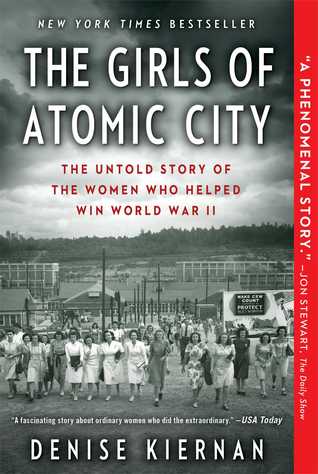
The Girls of Atomic City: The Untold Story of the Women Who Helped Win World War II by Denise Kiernan

My father was a pathologist, with an interest in oncology. He was a pioneer in the work towards a cure for leukemia, and his quest took him on many unique journeys, both scientific and literal travels. He had this idea that you could inject an isotope into an infected guinea pig, and be able to read the path of the disease in the animal's body. He worked for the National Institutes of Health, and it was his resources there that allowed him to drive the family station wagon out to this place in Tennessee, and pick up a substance to help in the refining of his idea. Whatever it was that he picked up, was in a lead-lined box, and we kids weren't allowed near the box, or the car, when he got home. I remember him washing the car, inside and out, to "make it safe" for the family to ride in again. (I remember, because it was the only time I saw him ever wash the car. It was something relegated to his sons and daughter to do.) Daddy took the box to his lab and went on with his experiments. His career was illustrious, and his work brought him a nomination for the Nobel prize (he found out after the fact) and was the basis for other people to win the prize itself (which was a sore point for him.) The empty box hung around the lab, then came to our home where it was used as a door stop for years. The base has been lost, but we actually still have the lid, and some weights used to help keep the top secure on the car ride between Tennessee and Maryland. (My husband says that early exposure to radioactive material explains a lot about my family. I just glare at him.)

Maybe it was my childhood awareness of Oak Ridge, maybe it was my love of history, but I had put this book on my reading list. A friend sent it on to me (thank you Nancy!) when she saw I was interested in it. Such a fascinating collection of people, in a fascinating time and place. All were very ordinary, and very extraordinary at the same time. The secrecy surrounding the project, some of the rules and regulations, and the level of detail thought through in some areas (while totally ignored in others, such as what to do with the mud at the site, to allow people to get about) was fascinating. It did take me a little bit to keep the various people and their story lines straight (for though this is non-fiction, there are times when it really doesn't read as such.)

I found this a thoughtful and though-provoking look at history, and the women, from janitor to scientist, who helped build the atomic bomb. They did, indeed, change the world.

Sunday, February 2, 2014

A Tale Dark and Grimm by Adam Gidwitz

I've long maintained that the Brothers Grimm and Mother Goose are not for children. Adam Gidwitz proves my point, but actually makes more accurate versions of the stories accessible for the young, and the young at heart. Hansel and Gretel, in this book, are not poor, helpless children who use their brains to outsmart an evil witch -- they are kick-ass, sometimes helpless, determined, resourceful, smart kids who fall into misfortune, but toughen up, learn new skills, and fight their way (either by bravery, brain, or plain pluckiness) out of their difficulties. Gidwitz has incorporated several tales into this story of Hansel and Gretel, with true under-standing (read the book; that's not a typo). The narration style reminded me a little of grandfather talking about Wesley and Buttercup. Gobbled this up in one sitting.

Saturday, February 1, 2014

Wesley the Owl by Stacey O'Brien

I am a bird-lover, bird-watcher, and some say, bird-brain. When on a field trip out to one of the plantations, with my son's 3rd grade class, I overheard him tell a classmate who was wondering what type of bird they'd just seen fly overhead, "Ask my mom. She knows her birds." For the past few springs, we've had a pair of screech owls nest near our bedroom window, and they and their offspring put us on the path to The Way of the Owl. Owls abound here by Lake Frances -- I onetime heard the call of 4 different types in the evening. When my cousin came to visit, she brought this book with her, and passed it along to me, knowing my affinity for owls.

Wesley was a 4 day old injured fledgling barn owl when Stacey O'Brien, a biologist working with owls at CalTech met him. His injury was such that he could not be habilitated to survive in the wild successfully, and he was placed in Stacey's care. This book is the story of the remarkable relationship that followed over the next 19 years. It's a wonderful story, full of juicy facts for bird lovers, and wonderful stories for animal lovers in general, both heartwarming and heart-breaking. And yes, Wesley dies in the end, but not before surpassing the life expectancy of a barn owl in the wild, which is roughly 15 years. His distinct personality will remain with me as well as much that he and Stacey taught me. I also applaud the author, for she truly reshaped her life around her charge, even though she kept his presence in her life relatively quiet, for fear of activists who were bent on freeing "captured" wild animals setting Wesley loose into a habitat he would have been unable to survive.

The tag line for this book is "the remarkable love story of an owl and his girl."  I couldn't agree more.

Sunday, January 19, 2014

Hyperbole and a Half: Unfortunate Situations, Flawed Coping Mechanisms, Mayhem, and Other Things That Happened by Allie Brosh

My friend Amy/Spedbug  turned me on to Allie Brosh's blog. Then, Jenny Lawson started mentioning that Brosh has a book coming out soon, so I put it in my mental note file (which is wa-a-a-ay to full and needs to be cleared out) to pick it up when I could. But the nice things about books on your wishlist that come out in November, is that sometimes, people look at that list for this gift-giving event in December. So yay! My own copy!

Brosh's honesty is charming, eye-opening, heart-rending, and sometimes painful to read. She approaches mental health issues that most people skirt away from, or sweep into a closed. Her courage is what makes it easier to read (if she can write it, I owe it to her to read it) -- well, her courage, and her wonderful drawings that can capture so much with such sparse detail.

But the book is not all emotion -- there are some wonderful stories of life, dogs, a goose in the kitchen, and young post-op, still- anesthetized Allie wanting to go to a party. Love.

(One additional mention: Allie lived in Sandpoint Idaho for a bit and was friends with a friend of mine who lives there. One degree of separation!)

Sunday, January 12, 2014

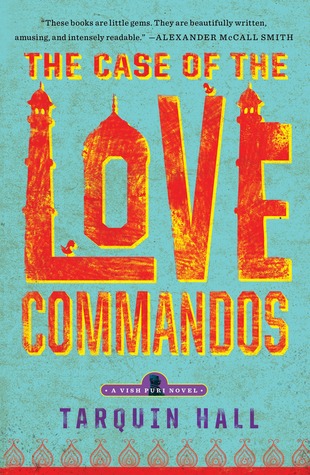
The Case of the Love Commandos (Vish Puri #4) by Tarquin Hall

I'm declining to rate this book, because I feel disloyal to Vish Puri and Tarquin Hall for not liking it as much as I have the other 3 books. Maybe it's because my brain is whirling at a faster pace right now (We sold our house! We are house hunting! We are moving! Soon!), but I really had a tougher time reading this, and found myself skim reading at some points. I fully admit the fault is mostly mine. Tarquin Hall has again placed his familiar, truly human characters in another (actually several) situation(s) which require the skill of India's premiere detective (and his mother) to solve. It fascinates me how Hall manages to weave so much of India's social traditions and problems into each story, as well as keeping to a realistic blend of Indian and Hindi in the language. If you are in India, speaking English there, the language bears a smattering of native language/vernacular  quite naturally.  And though I know (or knew at one point) a large number of the terms dotted in the narrative, a glossary is thoughtfully provided.

This time, Vish Puri is feeling a little blue after a string of bad luck (for instance, he solved a case of a heist, but couldn't find the goods.) He's off with his wife and mother for a trip, when he gets called away by one of his agents to help find a missing groom. No, the guy hasn't gotten cold feet -- he's been kidnapped. He is of a different class than his beloved, and at the same time she's run away to run away with him, he vanishes. His mother, back in his village, turns up murdered, and the father of the bride to be is accused of the crime.

The twists and turns normally would be great fun for me, as well as watching Vish's ego and brains at work, but it just didn't fully cut it for me right now. Even the recipes at the end of the book didn't grab my interest, so I really must be preoccupied, because after reading, one of my favorite things to do is cook.

Forgive me Vish?

Wednesday, January 8, 2014

Death of a Nightingale (Nina Borg #3) by Lene Kaaberbol, Agnete Friis

When I first read about this book, I was intrigued as it combined several elements or interests in my life: Nordic Noir, with a nurse as the central figure, and a woman from Ukraine as another major figure. It also promised a parallel story involving Ukrainian history. When the kind folks at www.bookreporter.com sent it to me as part of their Christmas give-away, I was quite the happy nurse-of-Ukrainian-heritage-Nordic-Noir-lover camper.

This is apparently the third in a series featuring Nina Borg, but the story didn't suffer in not having read the first books. Nina is definitely a flawed character, but also definitely one with a good heart. She has worked with immigrants, both legal and illegal, in Denmark. Through this work, she has befriended Natasha, a woman currently in jail for the attempted murder of her fiance, and Natasha's daughter, a child with severe asthma, who bears the emotional scars of her young life. When Natasha escapes from custody, while being brought to the police station, events begin to get interesting. One of two investigators in Denmark from Ukraine to question her disappears. Her fiance is murdered, and the killing is in the same fashion as Natasha's husband back in Ukraine had been killed just before Natasha fled for Denmark. The immigration camp where Katarina is being held while her mother is imprisoned is attacked in an attempt to get the girl. She only evades being kidnapped through the quick thinking of Nina, who has become attached to both the mother and the daughter. While the police think all the crimes can be attributed to Natasha, Nina is unconvinced. The figure she'd seen coming toward her as she hid with the child was definitely a man, and the attack seemed more professional than a lone woman, who escaped on the spur of the moment, might be able to carry out.

The story unfolds, interspersed with the story of two sisters, growing up in Ukraine under the rule of Stalin. This part of the book fascinated me, with a glimpse of how life was for people in small towns and villages. Olga and Oxana's story would have made a good separate book, but it was skillfully interwoven with the tale of Natasha and Nina, culminating in a way I really didn't expect. I even was kept wondering if the Nightingale in the story related to Nina (as in Florence Nightingale) or as in either Olga or Oxana, the two sisters referred to as nightingales for their singing.

It is interesting to me that the story flowed so well with two writers, and makes me wonder how the work was dispersed. There were no continuity disruptions that I detected, aside from the obvious technique of intertwining stories. Some folks claim that female writers of mystery are "softer", though I don't necessarily agree. However, there was a difference in this book of some sort: very character driven, and while it involved politics and ugliness of the world, the violence and use of guns, explosions, and knives was less in the forefront. I'll have to ponder this a bit more, but I think I'll seek out the first two books in the series.
Saturday, January 4, 2014

One Hundred Names: A Novel by Cecelia Ahern

What is it that makes us each unique? For Kitty Logan, it's her missteps, particularly the huge one she made which has effectively ended her career as a television journalist. While licking her wounds, she finds herself at the bedside of her terminally ill friend, mentor, and editor of the magazine that launched her journalistic career. There the question is launched: what was the one story you would write that you haven't yet written? The answer Kitty receives lies in a folder tucked in folder -- a legacy from her mentor: a list of 100 names. But can she fulfill the legacy? Can she find what links these people on this particular list; find what makes them the final story?

At first, for me, bogged down in Kitty's selfishness and the mess she created for herself by not having true journalistic integrity, slowed the story down. But as she begins to seek out the people on the list to interview them, as she begins to see the world from a different perspective, not an ego-centric one, my interest quickened. The characters I met through Ahern, the view of Ireland, the backgrounds of the individuals, were all intriguing. I've often thought that even the person who may on first glance be boring or uninteresting has a story to tell. It just may take special eyes to see it. Luckily, for the reader, Kitty learns to see the world with new eyes, and Ahern has the skill to tell the tale.

Many thanks to the kind folks at LibraryThing, and to the publisher, for sending this copy of the book for me to read as my first book of 2014.