Sunday, March 17, 2013

When Ukrainian Eyes Are Smiling

St. Patrick's Day, for the past 29 years, makes me think of my honeymoon. Javaczuk and I were married on the Eastern Shore of Maryland on the Ides of March, 1984. Through the workings of fate, my mother, brothers and their wives were all with us on our honeymoon (that's what happens when you sneak off to get married during a family reunion.) We were staying in some cabins on Ball's Creek, where it intersected Broad Creek (I kid you not.)

Two days after we wed, the family consensus was to head to Tilghman Island for a pretty renowned seafood place, sure to satisfy the oyster lovers in the family. And so, we set off and drove from our creek over to the island for a feast -- to Harrison's Chesapeake House -- on St. Patrick's Day.

So, at Harrison's, they were having a huge St Patrick's Day party. So huge, that they weren't sure they could accommodate our group of 5 Nadels and 2 Romanczuks. For while we covered a fair number of nationalities within that group (Ukrainian, Scottish, German, more Ukrainian, and some Hungarian) we didn't have any of the green in our heritage. As we turned to leave, my eldest brother threw his arm around my shoulder, and announced in a loud voice not to worry, little sister. We'd find somewhere else to celebrate the marriage.

Someone overheard him (as I'm sure was his intention), and we quickly found ourselves at a table, with a buffet of oysters, served 20 ways. Plus there were other delicacies: fresh shrimp, crab, fish, all from the Chesapeake Bay. We laughed and ate. Drank and ate. Toasted the new bride and groom and ate. Ate and ate. Sang along with the rather drunken band playing Irish tunes, and ate. People sent us drinks and toasted us some more. I made it through about 5 or 6 ways to have oysters, and then had to undo the button on my trousers and let the zipper out a little, so that I could breathe. I was totally stuffed to the gills with gills, and molusks, and other delights of the sea.

As I watched the room through a rosy glow of abundant food, drink, family, and love, the band leader came to our table. He said he wanted to offer us a toast. Javaczuk and I smiled at him. The fellow then hauled me to my feet, and pulled me to the center of the room with him, where he began a drunken toast, and an even more inebriated version of "When Irish Eyes Are Smiling." The whole room sang along, toasting us, (my groom at the table with my family, and the oyster-filled bride, being clutched by a soused Irishman, in front of 100 people singing to her.)

And what was I doing? I was hoping my unbuttoned, unzipped trousers wouldn't tumble down. I am convinced they were held up by the miracle of St Patrick.

Friday, March 15, 2013

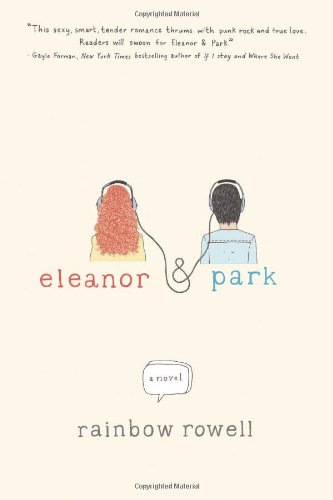
Eleanor & Park by Rainbow Rowell

Not fair. I'm still recovering emotionally from John Green's Hazel and Augustus from The Fault in Our Stars. Then Rainbow Rowell goes and introduces me to Eleanor and Park. I'm not sure how much more my heart can hold!

Having experienced adolescent first love, there's really nothing poetic about it. It's awkward. All those hormones rushing about and bodies changing. Just a mess. But when you add in social circumstances that heavily weigh the scales to the "sometimes life really hands out bad stuff" side of things, love can get complicated. Eleanor and Park are about as far apart as two people can be in most ways -- except they both are smart and have incredible hearts, with huge capacities, and untapped depths. The gentle unfolding of their friendship and love is a lovely thing to witness. The language of the novel is fluid, beautiful, and laced with imagery that makes the reader stop to pause to absorb it all. The story is told from alternating points of view of Eleanor, large, lumpy, colorful, living in an abusive family situation, and Park, half-Korean, passably popular, into alternative music, part of an close knit extended family.

So much about this book struck home: the whole kids can be really cruel bit, sibling love and sibling rivalry, the awful things people do for love in bad relationships, and the beautiful, heartwarming ones done for love. If you've ever been fat, or short, or skinny, or had the wrong hair, or wore red shoes that the other kids laughed at, or were the new kid, or wore clothes that weren't the current fashion but not because you wanted to or even knew the difference, or were not the usual in any way, you'll be able to identify with "Big Red" as she struggles to find a place in a new school, where the only faces who smile back are those on the edge of the crowd, too.

I seriously loved this book.

Here's a link to a NYT review by John Green. Yes, the same one who broke my heart and made me cry over Hazel and Gus.

Sunday, March 3, 2013

The Troubled Man, by Henning Mankell

Oh (expletive deleted.) I so didn't want this book to end the way the epilogue did. I saw it coming, and with each foreshadow said, "No! No! No!) I'm shattered.

It was a little disconcerting when I first started reading, because the last one in the series I read was actually the second book, where Kurt met Baiba. This one takes place 15 years after he last saw her. I hadn't realized, when I started reading, that "The Troubled Man" was announced as the last Wallender book. Now I'm sitting here snuffling and wiping tears away, as I absorb that I've lost yet another old friend and favorite series. The story was a good mystery, but the personal details of Wallender's relationship with Linda, Mona, and Baiba really got to me, as did his fears of following in his father's footsteps. I, too, have the worry of losing my memory as I age, and felt that Mankell did a beautiful job putting the reader in Wallender's thoughts and fears. I have read the series out of order, so still have a few books to go back and read -- thank goodness.

Goodbye, Kurt. May you live your final years surrounded by the love of your family. You've earned it. I'll miss you.

Monday, February 18, 2013

Midnight, by Kevin Egan (release date July 3, 2013 by amazon, May by Tor)

There are some nights when insomnia actually pays off.

I received an AR copy of Midnight yesterday, and, thanks to a convenient break in my reading line-up, could slip it in right away. The premise is Judge Alvin Carter happens to die in his chambers on December 31. While that might seem a tidy way to end a year, it puts his law clerk and his secretary in a bit of a bind; by the traditions of the New York County Courthouse their jobs would be safe until the end of the year a seated judge dies, but the end of the year is only hours away. Not much help for a financially strapped single mom and a fellow up to his ears in gambling debts. What to do? Simple. Make it look like the good Justice kicked off on January 1 instead.

The plot gets convoluted --  ham-fisted loan sharks, crooked politicians, nasty enforcers, even an ex-boyfriend. Plus, the dead judge goes on a bit of a walk-about.

The author has spent his career in the New York law system, so the scenarios and specifics of the culture rang true. There were only a few moments where my attention wandered because of small details.

So, when I found myself wide awake at half past stupid last night, rather than struggle to resume sleeping, I crept downstairs, made a nice cup of herbal tea, wrapped myself in an afghan, and finished the book. Like Carol and Tom, I tried to turn a losing proposition into a winning one. Only my case was much less of a struggle.

Saturday, February 16, 2013

Lessons in French by Hilary Reyl

Paris is not a city that attracts me, yet it does fascinate me. It's not a place I long to go (one brief visit in the 1970's has allowed me to say I've been there), but it's a city I do love to read about. Whether historical, twentieth century, or current, the nuances of culture never cease to give much to contemplate. Hilary Reyl has managed to capture a believable Paris of 1989-90 and present it to her readers, along with tasty morsels of the time: the fall of the Berlin Wall, Salman Rushdie (Satanic Verses era), how Parisian women really stay thin, kirs, a compelling circle of characters, and of course, cuisine.

The story is billed loosely as a coming of age novel, which really sells it short, because I found it to be a fascinating character study, with Paris itself one of the characters to study. Kate, a recent Yale graduate, has the opportunity to work as the assistant to Lydia, a famous American photographer, living in Paris. Kate had lived briefly in Paris as a girl, and speaks the language beautifully. While the job bubbles with opportunities to mix with the famous, and be a part of a cutting edge culture, Lydia and her family serve up a somewhat toxic brew of personal pathologies and pathos. Kate must find a balance as well as find herself. She still has family in the city, has a group of young aristocrats and royals she runs with, as well as the conflicted personalities that come her way, courtesy of Lydia's family.

There were times when Kate's hormones led her astray, where I wanted to give her a shake to help her think straight, but that's part of what coming of age is all about. The thing that kept me glued to the pages here were the glimpses of Paris that emerged, the slices of life not known to those who have only visited, (whether in person or via a book) -- a little of the underbelly, so to speak. It rang so true that I feel certain Reyl knows her stuff, and weaves it in a clear, confident manner, into the story of Kate and her time in Paris.

Thank you to LibraryThing's Early Reviewer Program and the publisher for sending me this AR copy to read. The book comes out March 5, 2013.

(3.5 rounded up to 4 stars)

Sunday, February 10, 2013

Rocks in my Heart

There are many quirks that made my mother the gem she was, a multifaceted bit of brilliance. Though she was trained as a bacteriologist (in the days before virology and even microbiology were even being contemplated) one of her passions were rocks. I'm not talking the shiny polished bits found in gift shops along Route 66, but Rocks. Rocks, stones, pebbles, minerals: raw bits of compressed earth, in glorious shapes, hues, and textures.

When I was 4 (fifty-mumbly-mumble years ago) the family moved to Palo Alto so my father could be part of a project at Stanford University. My parents loaded up our baby blue Country Sedan station wagon and drove from Silver Spring, Maryland, out to the west coast. I still have vivid memories, and a ton of stories about that trip. My father learned to slow his driving speed as we drove past cuts the newly built highway had made into the land. The geographical layers were exposed, creating a classroom where my mother taught us to distinguish geologic columns (or what I called "rock layers" at the time. If the slice into the earth was particularly stunning, the old blue wagon pulled to the side so a certain rock enthusiast could explore. One time, as we scrampled over the shale and sedimentary rocks, my father gave a rather embarrassed explanation to a highway patrol trooper who thought we were a vehicle in distress. I don't know what my dad said, but I heard a roar of laughter from the super-sized trooper. He slapped my dad on the back, and said, "Gotta to keep 'em happy. It pays."

That trip was a rock hunter's heaven -- caverns, the Badlands, southwest, Petrified Forest, Painted Desert, Rockies, . It was also the beginning of my mother's love affair with the Grand Canyon. Her rock collection grew that summer, with bits of earth and rock she collected as we travelled. It set the pattern for later trips, when the souvenirs brought home were minerals and stones.

She never stopped collecting. Her children, friends, and even friends of her children brought her rocks, sand, and bits of dirt from all over the world.  There was the hunk of obsidian that got pulled up in a fishing boat net off the Pacific coast, sand from Goa, geodes from caves in the midwest, pebbles from the top of a hill in India. It was an astounding array of bits of the Earth's crust. And it travelled around the country as she moved from Maryland, to Missouri, to South Carolina. On that steamy August day, when her moving van arrived here in Charleston, the movers lugged her boxes up the 15 stairs to our front porch. She hadn't labeled contents, just rooms on the boxes, because between her books, and her amateur geologist stash, she was afraid that they'd charge her more for the move. I stood on the porch, offering iced tea and cold water to the perspiring men. One fellow huffed up the steps, face bright red, cords on his neck straining. He grinned at us and laughed. "Whatcha got in here, lady? Rocks?" As a matter of fact...

Bumma and I talked about what to do with her rocks when she moved on. She always meant to label them all, but didn't get around to it, though could tell me where each one was from and what it was. I should have written it down, but didn't. We used to joke that maybe we should leave them all in a heap in the back yard, to confound future geologists. What she wanted, though, was, when we were ready to part with them, that the collection go where it might spark a love of rocks in someone else. She wanted people to be able to learn through those wondrous bits of earth.

Ruthe's rocks are all now in boxes, except for a few chosen by family members to keep as memories. Next week the collection moves to a new home, at Ashley Hall, a private school, where my parents sent me to high school when we relocated to Charleston. My mother once commented how different Ashley Hall was from her public school back in Brooklyn in the 20's. She wondered what her world might have been like if her education had taken her to such a place, if she'd had the opportunity to enrich her mind in that environment when she was a girl.

It makes me smile to think that my mother, after all these years, will indeed be going to Ashley Hall, to be a part of learning.

Monday, January 28, 2013

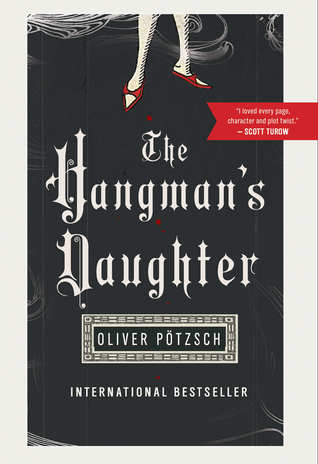
The Hangman's Daughter by Oliver Potzsch: CSI in Medieval times.

The Hangman's Daughter is a murder mystery back in the days well before CSI or even Sherlock (though several centuries after Brother Cadfael). Schongau, Germany in the 1600's is the setting. This happens to be one of my favorite areas of Germany, so it was fun to revisit it in a different era, sort of like a time machine.

An orphaned village boy is murdered, and witchcraft is suspected. The local midwife, who has saved the lives of village mothers and brought village babies into the world is accused, arrested, and to be "questioned" regarding the crimes. Jakob, the local Hangman, is determined to unravel the mystery, and save the woman who helped his wife give birth to his children from being burned at the stake. At the same time, he is the one, who by his very job, who must apply the persuasion (aka torture) that accompanies the village Aldermen's questioning to produce a confession of witchcraft.

The book bears the title of The Hangman's Daughter, though, not The Hangman. It is Jakob's daughter Magdelena, and university trained doctor Simon, who help Jakob in his investigation. Magdelena is the kind of character I like: smart, feisty, adventurous, inquisitive, and willing to go against the norm for the cause of justice.

I really liked the slice of history shown in this story. It always fascinates me that the wise women, or herbalists, who saved so many lives, were the very ones accused of witchcraft when something went wrong. Given that logic, and given the state of our world today, should we jail all the physicians to fix the ills of the world?