There are some nights when insomnia actually pays off.
I received an AR copy of Midnight yesterday, and, thanks to a convenient break in my reading line-up, could slip it in right away. The premise is Judge Alvin Carter happens to die in his chambers on December 31. While that might seem a tidy way to end a year, it puts his law clerk and his secretary in a bit of a bind; by the traditions of the New York County Courthouse their jobs would be safe until the end of the year a seated judge dies, but the end of the year is only hours away. Not much help for a financially strapped single mom and a fellow up to his ears in gambling debts. What to do? Simple. Make it look like the good Justice kicked off on January 1 instead.
The plot gets convoluted -- ham-fisted loan sharks, crooked politicians, nasty enforcers, even an ex-boyfriend. Plus, the dead judge goes on a bit of a walk-about.
The author has spent his career in the New York law system, so the scenarios and specifics of the culture rang true. There were only a few moments where my attention wandered because of small details.
So, when I found myself wide awake at half past stupid last night, rather than struggle to resume sleeping, I crept downstairs, made a nice cup of herbal tea, wrapped myself in an afghan, and finished the book. Like Carol and Tom, I tried to turn a losing proposition into a winning one. Only my case was much less of a struggle.
Monday, February 18, 2013

Saturday, February 16, 2013
Lessons in French by Hilary Reyl

The story is billed loosely as a coming of age novel, which really sells it short, because I found it to be a fascinating character study, with Paris itself one of the characters to study. Kate, a recent Yale graduate, has the opportunity to work as the assistant to Lydia, a famous American photographer, living in Paris. Kate had lived briefly in Paris as a girl, and speaks the language beautifully. While the job bubbles with opportunities to mix with the famous, and be a part of a cutting edge culture, Lydia and her family serve up a somewhat toxic brew of personal pathologies and pathos. Kate must find a balance as well as find herself. She still has family in the city, has a group of young aristocrats and royals she runs with, as well as the conflicted personalities that come her way, courtesy of Lydia's family.
There were times when Kate's hormones led her astray, where I wanted to give her a shake to help her think straight, but that's part of what coming of age is all about. The thing that kept me glued to the pages here were the glimpses of Paris that emerged, the slices of life not known to those who have only visited, (whether in person or via a book) -- a little of the underbelly, so to speak. It rang so true that I feel certain Reyl knows her stuff, and weaves it in a clear, confident manner, into the story of Kate and her time in Paris.
Thank you to LibraryThing's Early Reviewer Program and the publisher for sending me this AR copy to read. The book comes out March 5, 2013.
(3.5 rounded up to 4 stars)
Sunday, February 10, 2013
Rocks in my Heart

When I was 4 (fifty-mumbly-mumble years ago) the family moved to Palo Alto so my father could be part of a project at Stanford University. My parents loaded up our baby blue Country Sedan station wagon and drove from Silver Spring, Maryland, out to the west coast. I still have vivid memories, and a ton of stories about that trip. My father learned to slow his driving speed as we drove past cuts the newly built highway had made into the land. The geographical layers were exposed, creating a classroom where my mother taught us to distinguish geologic columns (or what I called "rock layers" at the time. If the slice into the earth was particularly stunning, the old blue wagon pulled to the side so a certain rock enthusiast could explore. One time, as we scrampled over the shale and sedimentary rocks, my father gave a rather embarrassed explanation to a highway patrol trooper who thought we were a vehicle in distress. I don't know what my dad said, but I heard a roar of laughter from the super-sized trooper. He slapped my dad on the back, and said, "Gotta to keep 'em happy. It pays."
That trip was a rock hunter's heaven -- caverns, the Badlands, southwest, Petrified Forest, Painted Desert, Rockies, . It was also the beginning of my mother's love affair with the Grand Canyon. Her rock collection grew that summer, with bits of earth and rock she collected as we travelled. It set the pattern for later trips, when the souvenirs brought home were minerals and stones.
She never stopped collecting. Her children, friends, and even friends of her children brought her rocks, sand, and bits of dirt from all over the world. There was the hunk of obsidian that got pulled up in a fishing boat net off the Pacific coast, sand from Goa, geodes from caves in the midwest, pebbles from the top of a hill in India. It was an astounding array of bits of the Earth's crust. And it travelled around the country as she moved from Maryland, to Missouri, to South Carolina. On that steamy August day, when her moving van arrived here in Charleston, the movers lugged her boxes up the 15 stairs to our front porch. She hadn't labeled contents, just rooms on the boxes, because between her books, and her amateur geologist stash, she was afraid that they'd charge her more for the move. I stood on the porch, offering iced tea and cold water to the perspiring men. One fellow huffed up the steps, face bright red, cords on his neck straining. He grinned at us and laughed. "Whatcha got in here, lady? Rocks?" As a matter of fact...
Bumma and I talked about what to do with her rocks when she moved on. She always meant to label them all, but didn't get around to it, though could tell me where each one was from and what it was. I should have written it down, but didn't. We used to joke that maybe we should leave them all in a heap in the back yard, to confound future geologists. What she wanted, though, was, when we were ready to part with them, that the collection go where it might spark a love of rocks in someone else. She wanted people to be able to learn through those wondrous bits of earth.
Ruthe's rocks are all now in boxes, except for a few chosen by family members to keep as memories. Next week the collection moves to a new home, at Ashley Hall, a private school, where my parents sent me to high school when we relocated to Charleston. My mother once commented how different Ashley Hall was from her public school back in Brooklyn in the 20's. She wondered what her world might have been like if her education had taken her to such a place, if she'd had the opportunity to enrich her mind in that environment when she was a girl.
It makes me smile to think that my mother, after all these years, will indeed be going to Ashley Hall, to be a part of learning.
Monday, January 28, 2013
The Hangman's Daughter by Oliver Potzsch: CSI in Medieval times.
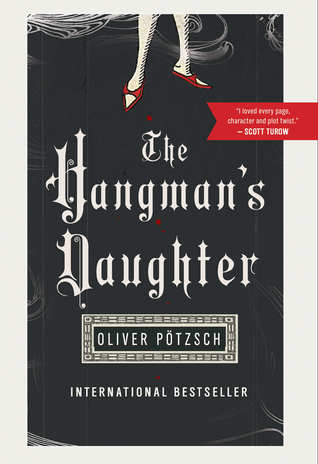
An orphaned village boy is murdered, and witchcraft is suspected. The local midwife, who has saved the lives of village mothers and brought village babies into the world is accused, arrested, and to be "questioned" regarding the crimes. Jakob, the local Hangman, is determined to unravel the mystery, and save the woman who helped his wife give birth to his children from being burned at the stake. At the same time, he is the one, who by his very job, who must apply the persuasion (aka torture) that accompanies the village Aldermen's questioning to produce a confession of witchcraft.
The book bears the title of The Hangman's Daughter, though, not The Hangman. It is Jakob's daughter Magdelena, and university trained doctor Simon, who help Jakob in his investigation. Magdelena is the kind of character I like: smart, feisty, adventurous, inquisitive, and willing to go against the norm for the cause of justice.
I really liked the slice of history shown in this story. It always fascinates me that the wise women, or herbalists, who saved so many lives, were the very ones accused of witchcraft when something went wrong. Given that logic, and given the state of our world today, should we jail all the physicians to fix the ills of the world?
Sunday, January 20, 2013
The Fault in Our Stars, by John Green

Here's a book that I was just too damn cheap to buy full price, even though the cover blurb grabbed me when I first came across it. So, I waited my turn at the library, and finally got lucky when the audio version was added to the collection (still haven't gotten my call for the hard copy.) This was no problem for me, as I enjoy audio versions, both when driving or for listening to when I'm doing tasks around the house. For this book, though, I invented tasks as an excuse to listen. When those ran out, I just sat like a lump and followed Hazel and Gus through their days.
This is a book that reaches out and grabs your heart from the get-go. Green has created powerful characters, brought us into their everyday world, and made it vibrant, heart-wrenching, and beautiful. This is not always an easy task, for there's very little about cancer that is beautiful. But there is a great deal that is glorious in the two young people in this story. Synopses abound. Go read one if you wish, but it cannot adequately prepare for how engaging this story is.
A bonus to the audio version is that there is an interview with Green. I really appreciated his insights on the story, writing, life with cancer, and more. I also found out that he has done an audio version of the book, primarily for the fans of his vlog, who wanted to hear his inflections to the story. The audio version I listened to was superb, and as Green said, he was much happier to hear Hazel say, "you're so hot" in a female voice than in his lovely baritone.
Oddly enough, while reading this, I also read of Neil Gaiman's participation in An Evening of Awesome at Carnegie Hall presented last week by Hank and John Green.Watch the video, and you'll get to hear the stars of The Lizzie Bennet Diaries (which also involves Hank Green) read the wonderful section in the museum (won't say more because of spoilers.)
10 out of 5 stars. Yes, I liked it.
Thursday, January 17, 2013
Farewell Dorothy Parker, by Ellen Meister (Release date Feb 21, 2013)
Disclaimer: Every time I saw or thought of this book, "Just One of those Things" * began running through my head. And now it's in your head, too. Just one of those things, I guess.

On to my thoughts of this book. I'm a Dorothy Parker fan. I think we're a dying breed. So when I read that Ellen Meister, who is also a Dorothy Parker Fan, upon seeing all the Jane Austen spin-offs, had written a book around one of her literary favorites, I was in.
The premise of the story is clever. Movie critic Violet Epps, as fiery in her reviews as she is timid in her real life, manages through a quirk of fates, to unleash the ghost of Dorothy Parker. Violet's personal life is a bit of a mess in just about every aspect: love, family, work. The quick witted Mrs Parker jumps in to help Violet strengthen her resolve, grow a backbone, get some courage, which is both helpful and horrific. In turn, Violet works to get the ghost to resolve some issues.
The story itself is an interesting mix of Parkerisms, historical facts, and poignancy. Violet's love life is a mess because of her timidity. She also is involved in a nasty battle for the custody of her beloved niece, orphaned the year before when Violet's sister and brother-in-law died. Plus she has a cut-throat assistant at the office to deal with. But her relationships with the niece, love interest, and co-worker ring true. This reader was able to follow her emotional growth, even though I did cringe each time Dorothy interfered as there were some disasters when she did so.
There were a few minor plot developments that irked me, but overall, I had fun reading this. I even pulled a couple of books of Parker's writings off the shelf to add to my "to be read" pile. My main problem with stories that revolve around a literary or historical figure being involved in a fiction book is that I often don't like how they are portrayed. While this characterization did not always match up to mine, it was fine. And probably, if I had met Mrs Parker in person, she would have terrified me.
*As Dorothy Parker once said to her boyfriend: "Fare thee well!"
As Columbus announced when he knew he was bounced: "It was swell, Isabelle, swell!
Wednesday, January 16, 2013
A Memory of Light by Robert Jordan and Brandon Sanderson (spoiler free)

When you've committed yourself to a series which was written over the course of 22 years, there are a great many emotions that come into play with the final book. First and foremost for me, was the sadness that Robert Jordan was not with us to see the series completed. His death in 2007 was a huge loss to literary and fantasy fans, especially to those of us who knew him personally. However, if Robert Jordan could not finish the series himself, his sagacious widow/editor Harriet McDougal, and Tor Books selected Brandon Sanderson to weave together an ending. Sanderson used Jordan's ideas, notes, scattered writings, and dictation, with the expert assistance of Ms. McDougal and Jordan's two assistants (aka Team Jordan) to bring the series to its conclusion.
The story that began all those years ago, with three boys and a girl leaving the Two Rivers, drew to a close for me today. I can't say that I was as enamored of the final book as I was with the first, but given the length of the series, and the length of this book (909 pages hardback; 33 CDs in the audio version, both of which I read/listened to in the course of this journey), that's not surprising. Some of my favorite characters got less page-time than I would have liked. Character development was a bit uneven for this reader, and there was a bit more telling than showing as to the strengths/weaknesses of some. It was sad to say goodbye to many, though given this is an all-out fight for good against evil, and not a romance-chick lit, I knew that some friends would spin out of the pattern. It's been fun to speculate how much of the book was penned or envisioned by Jordan, how much by Sanderson, including who survived the Last Battle. Certainly, (and for this I am quite grateful), Sanderson did not try to imitate Jordan's style, and there were times that some of his writing tics were clear. I also found myself missing some of Jordan's familiar ones (she said with arms folded under her breasts.)
The final book leads up to the Last Battle, good versus evil. And though there was fighting both before and after, the chapter bearing that title was 200 pages long. I am not a great military historian, but even so, the battle played out across the pages with clarity. I'd been listening to the audio version prior to 37, so was grateful to have the map in the hard copy to help orient myself during the fighting. I still am uncertain how some characters got from point A in one scene, across the field to point B in another, but am determined not to give spoilers with my continuity concerns, or fan-girl questions.
There were some moments of brilliance, which helped to outweigh any dissatisfaction I had. Some of the cursing was among the most colorful I have ever heard (and enjoyed.) I draw comfort though, in the thought that there are neither beginnings nor endings to the turning of the Wheel of Time. The wind will continue to blow; the Wheel will continue to turn. The Wheel of Time, and all it has brought me, will continue to weave through the threads of my days. Tai'shar Jordan.
Disclaimer: I am a relative of a member of Team Jordan.
Subscribe to:
Posts (Atom)